

Ensuring that drivers and vehicle passengers use their safety belts is one of the most effective and cost-effective road safety measures a country can employ, with the potential to reduce the number of road fatalities by as much as 50%.
We know that seat belt use saves lives, but despite being a core road safety Key Performance Indicator (KPI), many countries do not regularly monitor seat belt wearing rates, including countries covered by the Eastern Partnership Road Safety Observatory. This makes it difficult to know the extent of the problem, or to measure the success of policies to promote seat belt use.
In 2025, increasing seat belt and child car seat use in Armenia was identified as a core goal of government policy to improve road safety. It was therefore at the request of the Ministry of Territorial Administration and Infrastructure and the Ministry of Internal Affairs of Armenia that the Observatory embarked on a small-scale study to establish a robust baseline on seat belt and car seat usage in Yerevan.
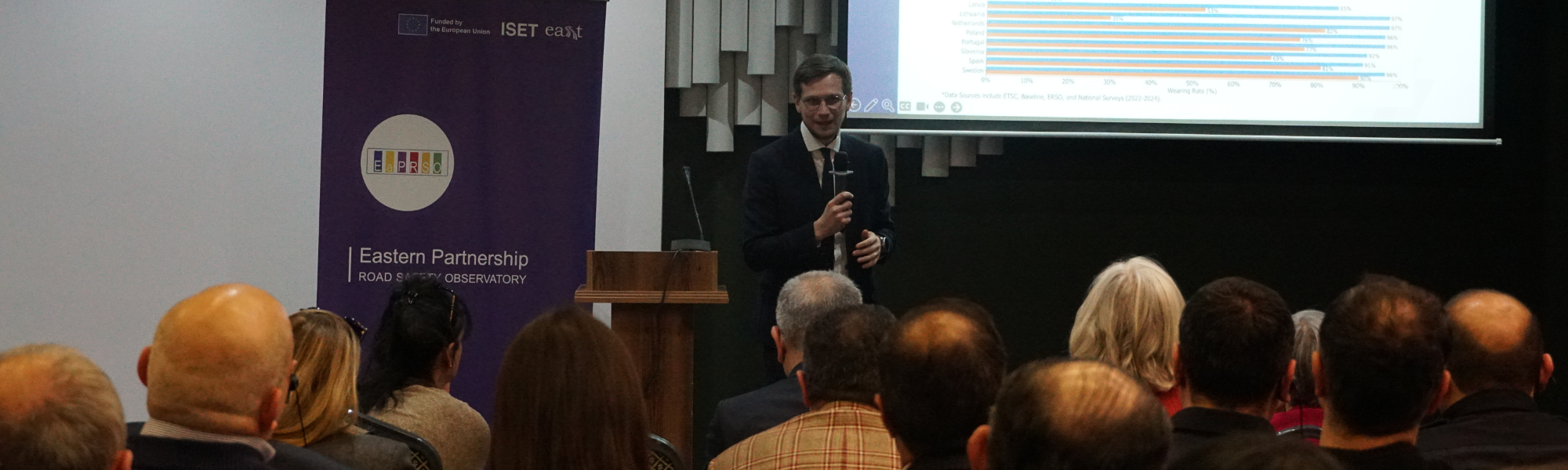
The study was implemented by MC Mobility Consultants and included a legislative review and observational roadside and vehicle inspection surveys, along with targeted training for law enforcement officers. Following a half-day training session with the Traffic Police on the implications of the study, the results of the baseline survey were publicly presented by Dovydus Skrodenis of MC Mobility Consultants in Yerevan on 29 January 2026.
The event was opened by HE Vasilis Maragos, Ambassador and Head of the Delegation of the European Union to Armenia, who welcomed the unique opportunity to apply insights of this study to save lives and re-enforced the message that seat belts remain one of the best vehicle safety devices we have to reduce the number of people who are killed or seriously injured on the roads.
The results of the study confirmed that seat belt wearing and car seat use in Armenia is indeed relatively low – particularly among back seat passengers. This is not unusual for the region, and low wearing rates are also a problem for a number of EU countries. It is therefore commendable that Armenia is leading the way in addressing this issue. The methodology developed by MC Mobility Consultants in measuring seat belt use is easily replicable and if implemented regularly by Traffic Police can provide useful and meaningful data upon which policies can be developed and implemented.
The study found Armenia to have good seat belt and car seat legislation which aligns with UNECE standards. Though it was noted that small amendments such as including the recommended maximum height of children for car seat use and increasing penalties for non-compliance could be strengthened.
Stronger enforcement, public awareness, technical inspections, and systematic monitoring of seat belt and car seat use were also recommended as important steps in improving usage rates. Interestingly, the study observed that drivers can be key influencers in ensuring seat belt use amongst their passengers with a significantly higher proportion of passengers wearing seat belts when the driver is also belted. Such insight and analysis can prove useful in developing campaigns and enforcement strategies that are effective and sustainable.
The study demonstrates Armenia's commitment to evidence-based road safety policy and sets a valuable precedent for other countries in the Eastern Partnership region. By establishing a baseline and developing a replicable methodology, Armenia is paving the way for improved monitoring and ultimately higher seat belt wearing rates across the region.


