

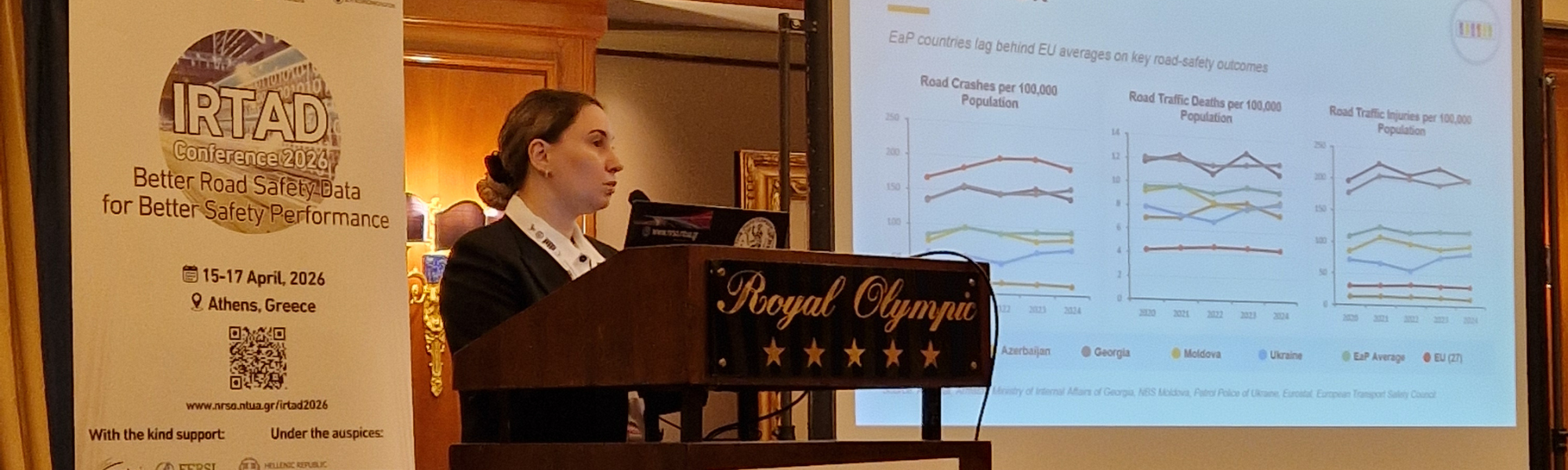
Despite continued efforts to improve road safety, the Eastern Partnership countries - Armenia, Azerbaijan, Georgia, Moldova, and Ukraine - continue to experience substantially higher road traffic fatality rates than the European Union. In 2024, the average road traffic fatality rate across the Eastern Partnership reached 9.5 deaths per 100,000 population, more than double the EU (27) average of 4.5. Road traffic crashes remain a major public health and development challenge, claiming thousands of lives each year and placing a significant burden on health systems, economies, and communities.
Traditionally, road safety has been measured using indicators such as the number of crashes, fatalities, and injuries. While these statistics are essential for monitoring trends, they tell us only part of the story. They reveal what happened, but they do not explain why certain countries achieve better road safety outcomes than others or where governments should focus their efforts to improve. This is where a broader approach becomes essential.
Road safety is shaped by many interconnected factors. Road infrastructure, vehicle safety, enforcement, institutional capacity, emergency response, driver behaviour, and wider socio-economic conditions all influence whether crashes occur and how severe their consequences become.
As a result, countries with similar numbers of fatalities may face very different underlying challenges. Likewise, countries with relatively good institutional frameworks may still experience poor road safety outcomes if weaknesses persist in other areas. Understanding these differences requires moving beyond traditional crash statistics and examining the entire road safety system.
To support this shift, the Eastern Partnership Road Safety Observatory has developed the EaP Road Safety Performance Index (RSPI) - a new benchmarking tool designed to provide a more comprehensive picture of road safety performance across Armenia, Azerbaijan, Georgia, Moldova, and Ukraine.
EaP Road Safety Performance Index
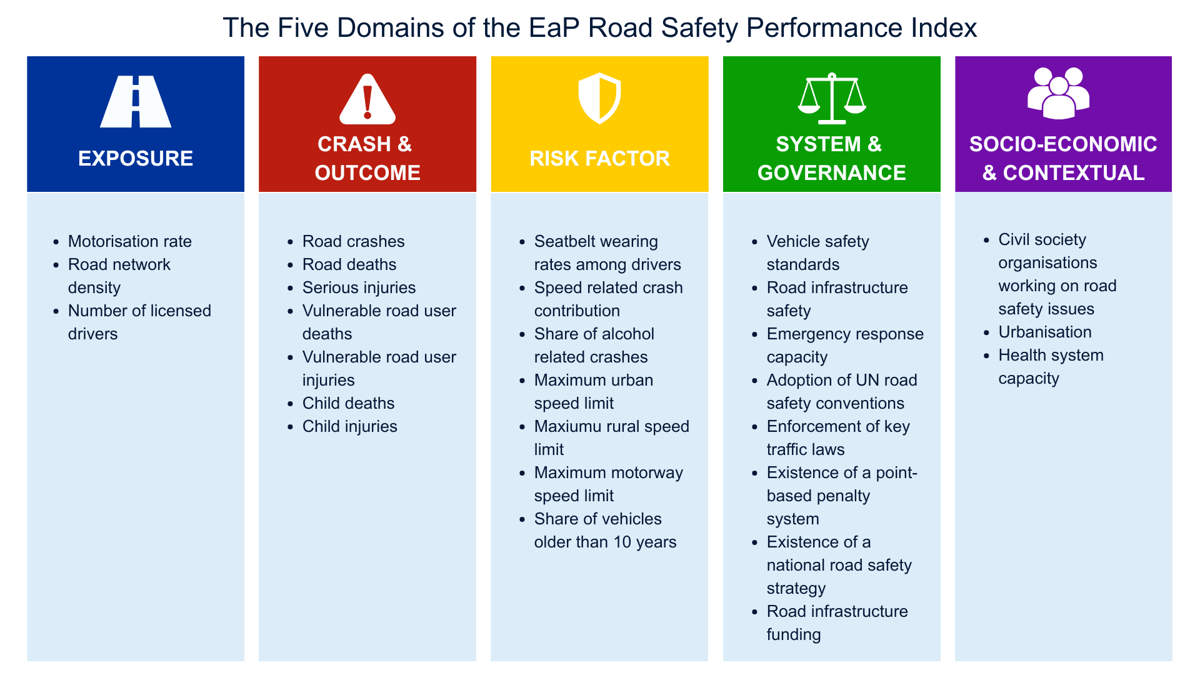
The EaP Road Safety Performance Index combines 28 indicators grouped into five key domains: exposure, crash and outcomes, risk factor, system performance and governance, and socio-economic and contextual. Together, these five domains provide a more complete picture of road safety than crash statistics alone. By examining the factors that influence road safety outcomes, the Index enables policymakers to understand where their country performs well, where challenges remain, and which interventions are likely to have the greatest impact. This supports a more strategic and evidence-based approach to improving road safety.
What does the EaP Road Safety Performance Index reveal?
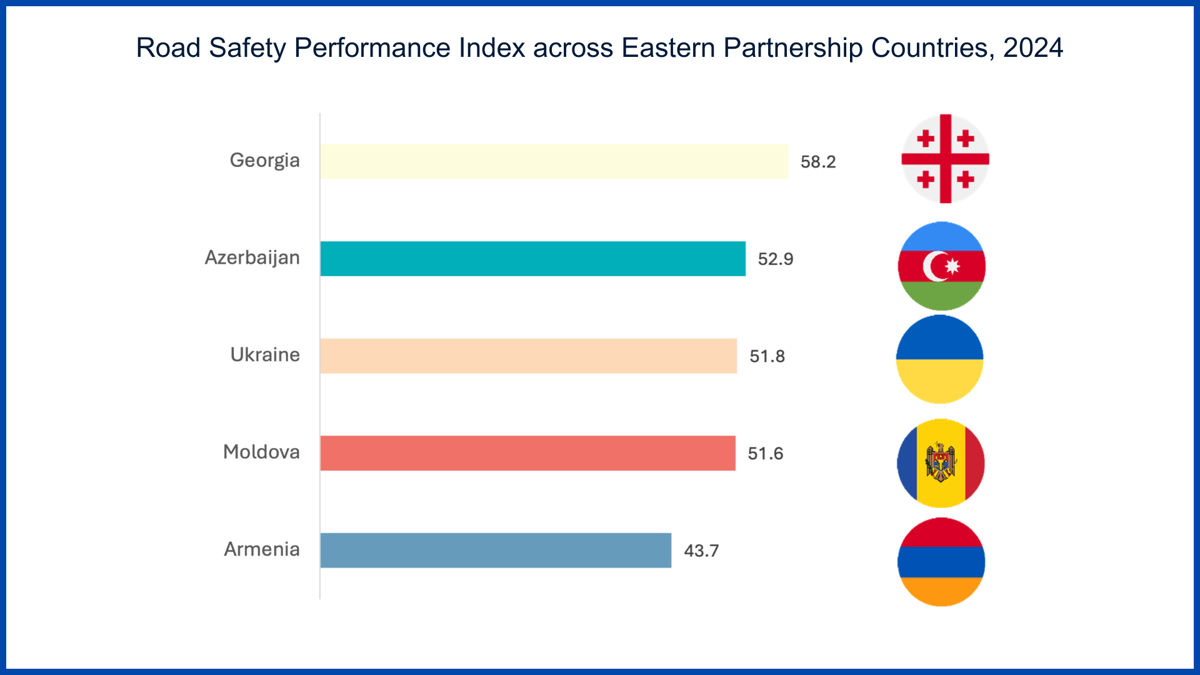
The EaP Road Safety Performance Index reveals differences in overall road safety performance across the region. The first Index report shows that, for 2024, Georgia achieved the highest overall score (58.2), while Armenia recorded the lowest (43.7). Azerbaijan (52.9), Ukraine (51.8), and Moldova (51.6) are closely grouped in the middle of the ranking. However, the overall scores tell only part of the story. Countries with similar rankings often display very different strengths and weaknesses, highlighting the need to look beyond a single composite score when assessing road safety performance.
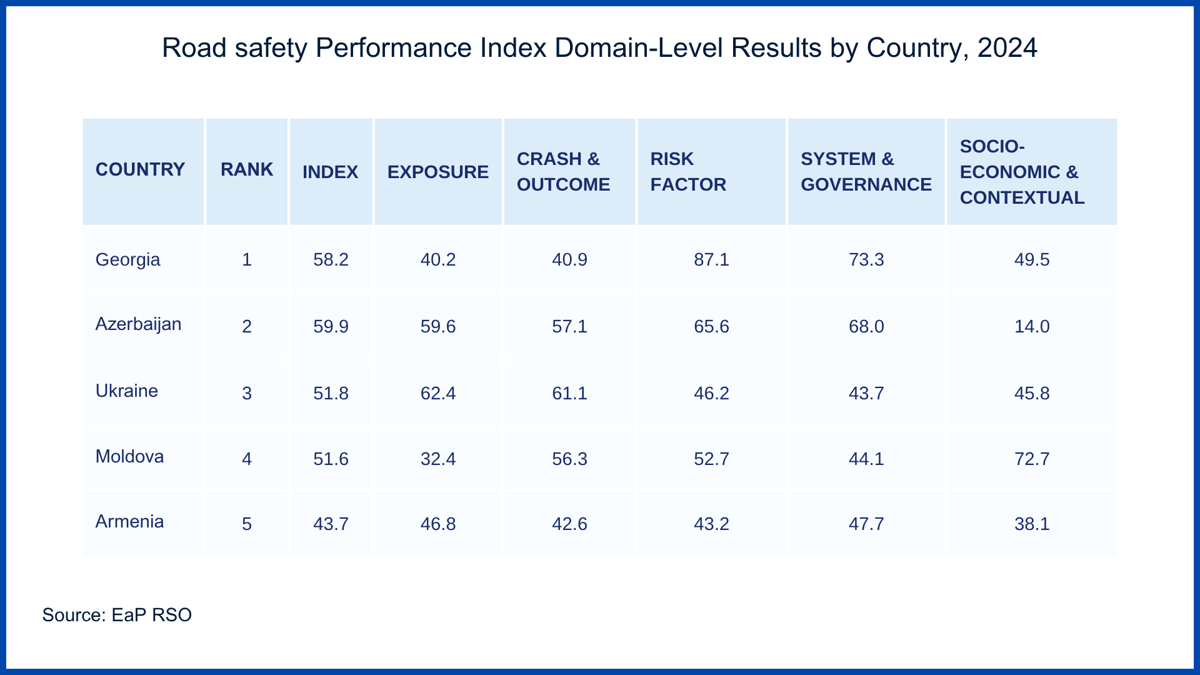
The domain-level results demonstrate that road safety performance is both uneven and multidimensional. No country consistently outperforms the others across all five domains, and each exhibits a distinct road safety profile. Georgia's leading position is driven by exceptionally strong performance in Risk Factors and System Performance and Governance, while its comparatively lower scores in Exposure and Crash and Outcome indicate that strong institutional arrangements have not yet fully translated into better safety outcomes. Ukraine performs best in the Exposure and Crash and Outcome domains, Azerbaijan stands out in System Performance and Governance, and Moldova records the strongest performance in the Socio-economic and Contextual domain. Armenia's lower overall ranking reflects comparatively weaker performance across several domains.
From Measurement to Action
The EaP Road Safety Performance Index is intended not simply as a ranking exercise, but as a practical diagnostic tool that helps policymakers identify strengths, pinpoint priority areas for improvement, and monitor progress over time. By revealing the multiple factors that shape road safety performance, it provides a stronger evidence base for designing targeted interventions and fostering knowledge exchange across the Eastern Partnership countries.
As road safety data become more comprehensive and harmonised across the region, the Index can continue to evolve and provide an increasingly robust basis for monitoring performance and informing policy decisions. More importantly, it encourages countries to look beyond headline crash statistics, identify the underlying factors influencing road safety outcomes, and target interventions where they can have the greatest impact. In this way, the Road Safety Performance Index supports a more strategic, evidence-based approach to improving road safety and contributes to the shared goal of reducing deaths and serious injuries on the region's roads.
Bibliography
CAREC. (2025). Azerbaijan Road Cash Data Review and Reporting: Status and Recommendations. Asian Development Bank.
CAREC. (2025). Georgia Road Cash Data Review and Reporting: Status and Recommendations. Asian Development Bank.
Charlotte, B., Paul, W., Charles, G., Fred, W., Letty, A., Victoria, G., . . . Elke, H. (2012). Developing a Road Safety Index. Deliverable 4.9 of the EC FP7 .
Elke, H., Tom, B., & Geert, W. (2009). Elaborating an Index Methodology for Creating an Overall Road Safety Performance Score for a Set of Countries.
Guadalupe, G.-S., María Isabel, O.-S., Elvira, M.-G., Mario, G.-B., & Antonio, G.-R. (2021). Needs for International Benchmarking of Road Safety Management Based on Mobility Exposure Measures and Risk Patterns. International Journal of Environmental Research and Public Health.
Milan, T., Elke, H., Krsto, L., & Dalibor, P. (2019). Iden fying the Most Signifi cant Indicators of the Total Road Safety Performance Index- Case Study: European Union. Journal of Traffic and Transportation Theory and Practice.
The United Nations Economic Commission for Europe (UNECE). (2024). Road Safety Performance Review - Moldova.
World Bank. (2020). Eastern Partnership-2020 road safety enforcement benchmarking study.
World Bank. (2024). Road Safety Country Profile - Georgia.
World Bank. (2024). Road Safety Country Profile - The Republic of Armenia.
World Bank. (2024). Road Safety Country Profile - The Republic of Moldova.


